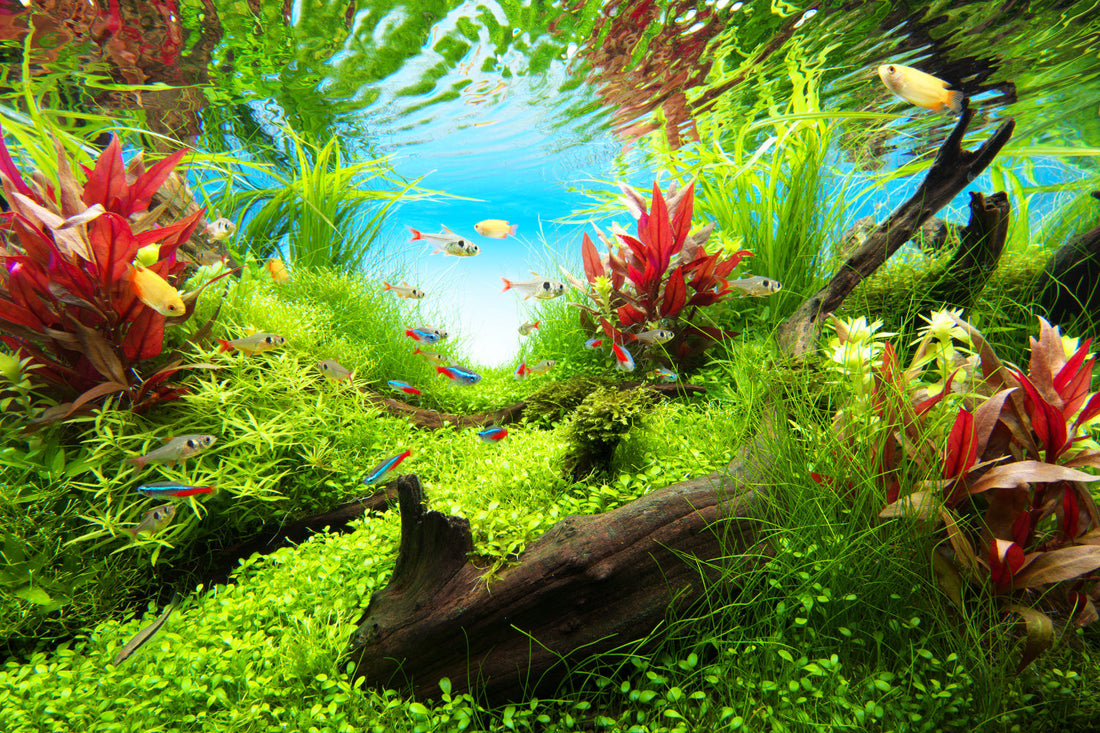
Aquatic plants are the heart of any planted aquarium, providing oxygen, biological balance, and a natural aesthetic. However, if your plants are dying, it's a sign that something is wrong. Let's explore the main causes and what you can do to save your plants.
1. Inadequate Lighting
Light is essential for photosynthesis, the process that allows plants to grow. If there is too much light, algae thrive; if there is not enough, plants cannot develop.
Solution:
-
Adjust the lighting time to 6-8 hours daily.
-
Consider the light intensity in PAR (Photosynthetically Active Radiation):
-
Low-demand plants: 30-50 µmol/m²/s
-
Medium demand plants: 50-100 µmol/m²/s
-
High-demand plants: 100-200 µmol/m²/s
-

2. Lack of Essential Nutrients
Plants need macronutrients (nitrogen, phosphorus, potassium) and micronutrients (iron, magnesium, zinc). If they show yellowing leaves, holes, or slow growth, it is a clear sign of nutritional deficiency.
Solution:
-
Introduce liquid fertilizers and fertilizer tablets into the substrate.
-
Maintains the parameters for nitrates (10-20 ppm), phosphates (0.5-2 ppm) and potassium (10-20 ppm).
-
We recommend daily liquid fertilization to provide the necessary nutrients for healthy growth in controlled doses.
-
Every 3 months, it is advisable to add solid fertilizers to the substrate to replenish essential nutrients.

3. Lack of CO2
Carbon dioxide (CO2) is essential for plant growth. If growth is slow and algae are present, it may be necessary to increase CO2 levels.
Solution:
-
Install a CO2 injection system and maintain levels between 20-30 ppm.
-
Adjust the diffuser for efficient dispersion throughout the aquarium.

4. Inadequate Maintenance
Excess waste, lack of pruning, and irregular cleaning compromise the health of plants.
Solution:
-
Siphon the substrate weekly.
-
Perform regular water changes (30-50% weekly).
-
Remove dead leaves and decaying plants.

Conclusion
Healthy aquatic plants depend on a balance of light, nutrients, CO2, and careful maintenance. If you notice signs of deterioration, quickly identify the cause and apply the necessary corrections. This way, your aquarium will remain a vibrant and balanced ecosystem, full of lush, healthy plants.


